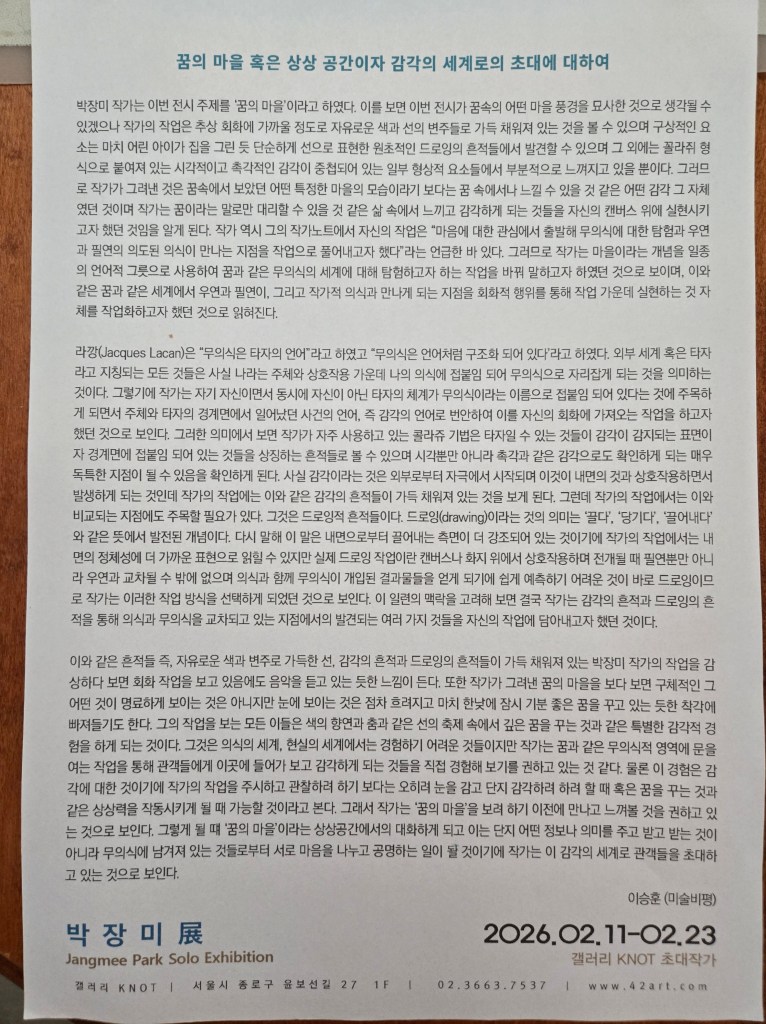
On the Dream Village: An Invitation to an Imagined Space and a World of the Senses
Park Jangmee titled this exhibition “Dream Village.” At first glance, one might think that the exhibition depicts a particular village landscape seen in a dream. However, the artist’s work is filled with freely evolving colors and lines, to the point that it approaches abstract painting. Traces of primitive drawing, expressed through simple lines as if a young child were drawing a house, can be found throughout the work. Alongside these are certain figurative elements in which visual and tactile sensations are layered and intertwined.
Rather than depicting a specific village seen in a dream, the artist seems to be expressing the very sensations that can be experienced and felt only within a dreamlike state. Through the concept of “dream,” she attempts to bring to the surface the things we experience and sense within our lives—things that may be difficult to express through ordinary language.
The artist herself has stated in her artist’s note:
“My work begins with an interest in the mind, and I seek to explore through my work the point where chance and the intentions of consciousness meet.”
In this sense, the artist uses painting as a kind of linguistic vessel through which she explores the unconscious world of dreams. Her work can therefore be understood as an attempt to transform into painting the point where chance and necessity, as well as the artist’s conscious awareness, encounter one another within a dreamlike world.
Consciousness and the Unconscious
Jacques Lacan stated that “the unconscious is the discourse of the Other” and that “the unconscious is structured like a language.”
Everything that is called the external world, or the “Other,” becomes attached to our consciousness through our interaction with it and eventually takes its place within the unconscious. The artist appears to focus on this system of the Other—something that is simultaneously part of oneself and yet not oneself—and to translate the events occurring at the boundary between the self and the Other into a language of sensation, bringing them into her paintings.
From this perspective, the collages that the artist frequently employs can be understood as symbols of things belonging to the Other that have become attached to the boundaries of our sensory experience. This becomes one of the distinctive aspects of her work: these elements can be experienced not only visually, but also through sensations such as touch.
Sensation begins with stimuli from the outside world and emerges through its interaction with what exists within us. Park Jangmee’s work is filled with traces of this sensory interaction.
There is, however, another important aspect that should be considered alongside these sensory traces: the traces of drawing.
The word drawing developed from a concept associated with meanings such as “to pull” or “to draw out.” In other words, it emphasizes the act of bringing something outward from within. For this reason, the artist’s drawings may appear to come closer to an expression of inner identity.
Yet when drawing actually unfolds through interaction with the canvas or surface, it inevitably encounters chance and coincidence. Consciousness and the unconscious become involved simultaneously, producing results that cannot easily be predicted.
This seems to be why the artist has chosen this particular way of working.
Considering the work in this context, Park Jangmee ultimately seeks to capture within her paintings the many discoveries that emerge at the point where consciousness and the unconscious intersect, through both sensory traces and traces of drawing.
An Invitation to Feel Rather Than Simply Look
When experiencing Park Jangmee’s works—filled with freely flowing colors, variations of line, traces of sensation, and traces of drawing—one can have the feeling that although one is looking at a painting, one is also listening to music.
When looking at her Dream Village, nothing specific or clearly defined necessarily appears before the eyes. Instead, what we see gradually becomes blurred, and we may find ourselves falling into the illusion of having a pleasant dream in the middle of the day.
Those who encounter her work are invited to experience something special: a deep sensory experience within a festival of color and a celebration of lines that seem to dance.
These are experiences that are difficult to encounter within the conscious and everyday world of reality. Through her work, however, the artist seems to open a door into a dreamlike, unconscious realm and invite viewers to enter it and experience directly what they encounter there.
Because this experience is fundamentally about sensation, it may not be achieved by simply concentrating on and observing the artwork. Rather, it may become possible when we close our eyes and simply allow ourselves to feel, or when we activate our imagination as if we were dreaming.
For this reason, the artist seems to invite us not to look at the “Dream Village” first, but rather to encounter it and feel it. When this happens, we begin to enter into a dialogue with the imagined space of the “Dream Village.” This dialogue is not simply an exchange of information or meaning. Instead, it becomes an act of sharing and resonating with one another through things that remain within the unconscious.
And it is into this world of sensation that the artist appears to be inviting her audience.
Lee, Seung-hoon – Art Critic